Moments Before Summer’s End
Posted on September 18, 2011 Leave a Comment
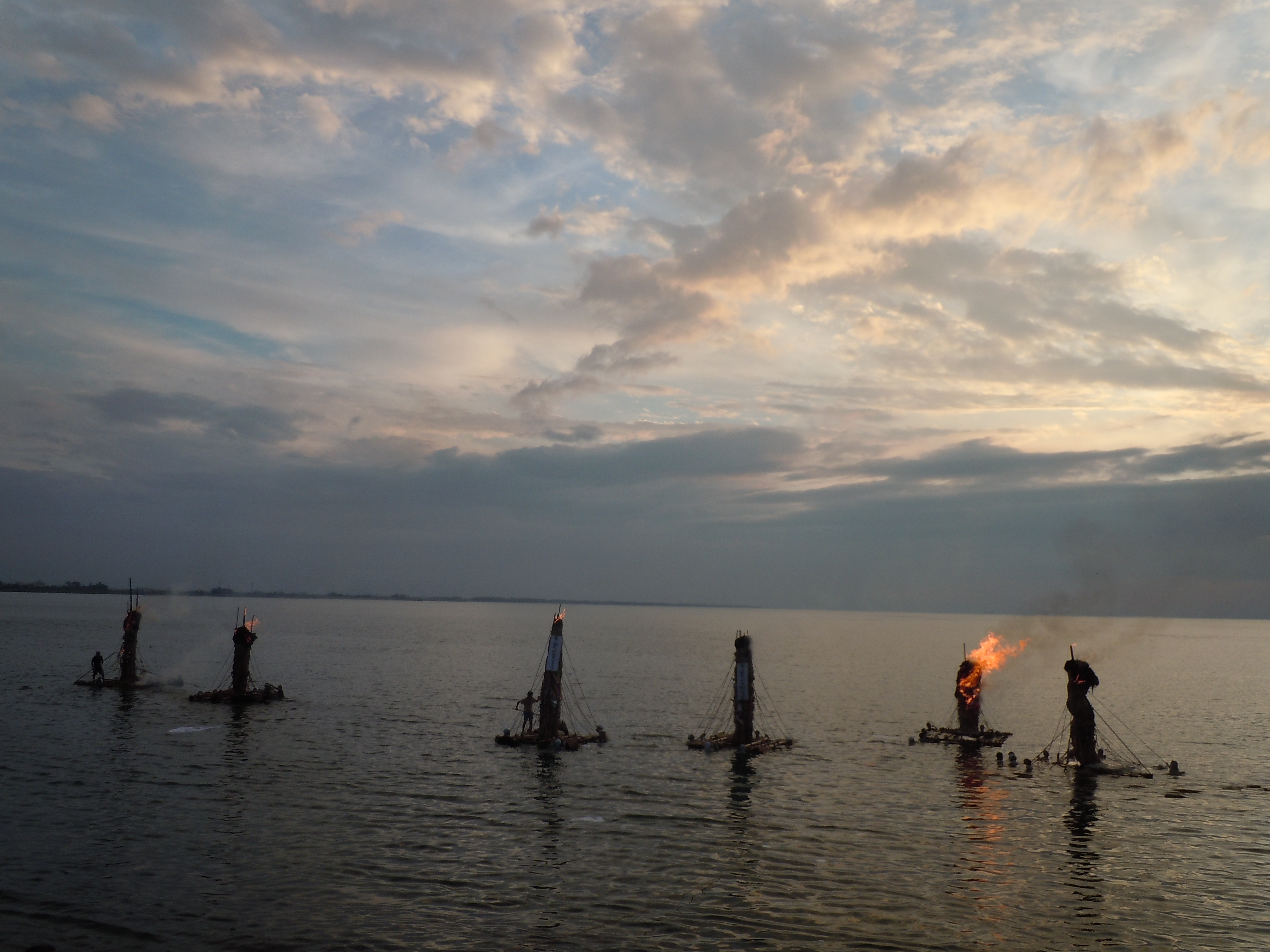
Namerikawa nebuta festival
The days are getting shorter, which sadly means summer is coming to an end. This week, I have had some time to reflect on my busy summer. In addition to spending 18 days back in Chicago with my family, I danced in a traditional Japanese festival, helped new ALTs get acquainted with their job at the Toyama Welcome Orientation and attended several other traditional Japanese festivals. I love that the Japanese savor every moment of summer. There are always festivals, fireworks and other events going on, even when there isn’t a public holiday. Below are some memorable moments from my summer.
Train Stories #3: The Man Who Cried Out
Posted on September 11, 2011 Leave a Comment
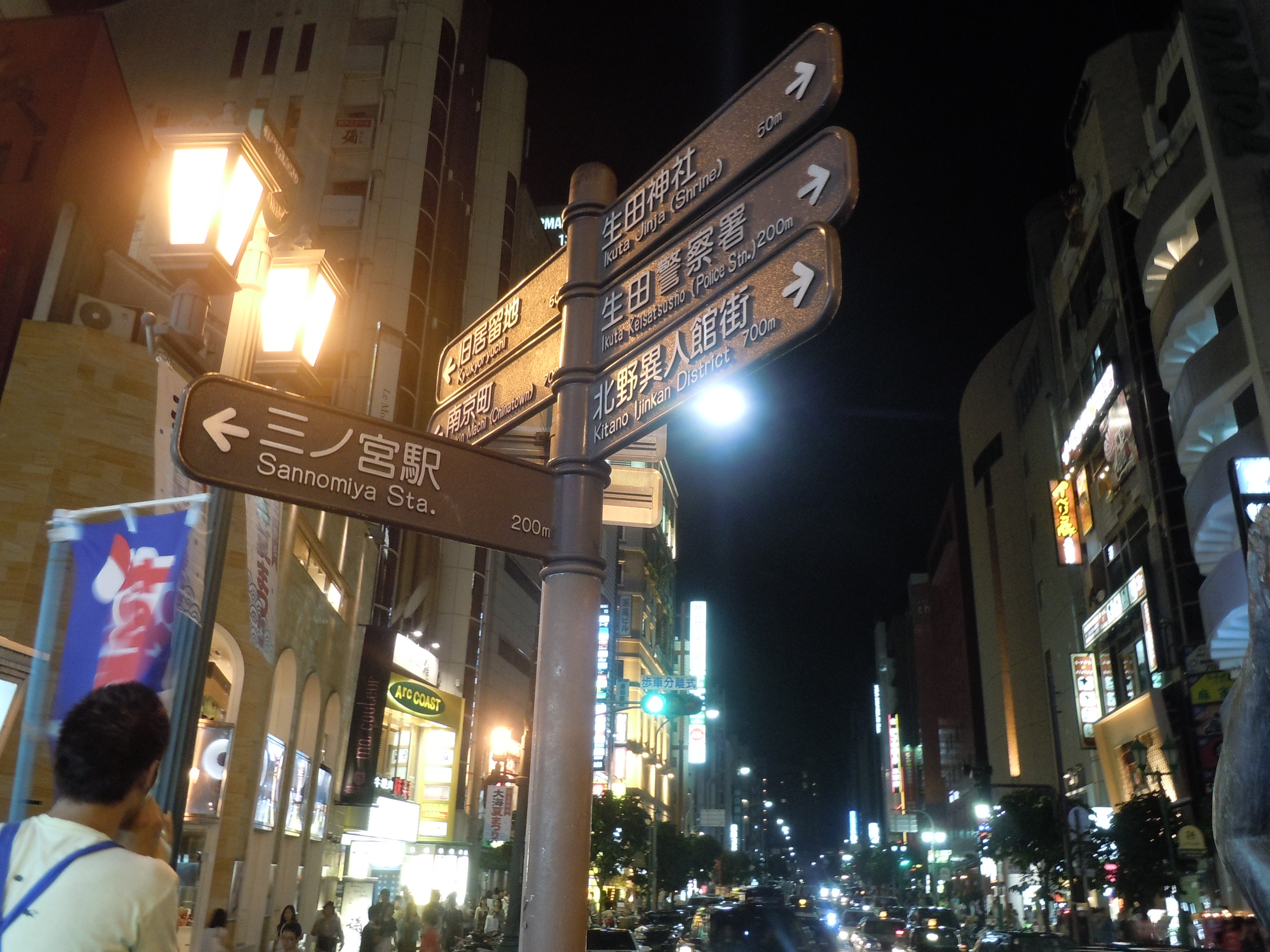
The signs of Kobe at night.
Fully recovered from a 7.2 magnitude earthquake that destroyed the city and killed thousands in 1995, Kobe is a trendy Japanese port city in the Kansai region of the country. With a population of about 1.5 million and close to Kyoto and Osaka, it is also one of the larger metropolises in Japan.
I recently spent a weekend there this summer with an American friend, admiring the local sites and enjoying the simple pleasures of people-watching. Life in bustling Kobe seemed very different from my slow-moving country life in Namerikawa: Elegant women in high-fashion walked with confidence around town in high heels; streets were lined with boutiques and coffee shops; and Kobe’s main train station (Sannoimya Station) was bustling at all hours of the day with people traveling to nearby Osaka and shoppers buying delicious Kobe waffles or other goods.
By all accounts, I had a great weekend: I ate at a lovely Mexican restaurant (foreign food is a rare find in Toyama); I saw an impressive dolphin show at the famed Kobe City Suma Marine Aquarium; and I enjoyed a lovely view of fireworks on top of Mt. Rokko.
But during my last hours in Kobe, I was reminded of how fortunate I am to be able to travel and see new things.
About two hours before my train back to Namerikawa was scheduled to depart, my friend and I wandered around Sannomiya Station to find our way to the correct platform. I was also struggling to find last-minute omiyage for some of my co-workers (it is a nice custom in Japan to bring back small candies/treats from a city you visit). As both of us looked around the station to find our bearings, an elderly man in his 60s or 70s limped toward us. I can’t remember his exact words, but he spoke in broken English.
“Please help,” he said. “I have no money.”
He lifted one of his pants up. His leg was almost all bone and covered in sores. He was skinny, a little unshaven and had a slight hunch. A little uncertain about what to do, I looked to my friend.
In America, I have been approached by several homeless people asking for money. On the streets of Chicago, it is common for panhandlers to beg for money in train stations or outside stores. While I have seen homeless men in Tokyo and Toyama, I had never been approached by a Japanese person asking for money. And although I am quite familiar with talking with and helping homeless people (I volunteered at my local PADs as a teenager and also wrote about homelessness for several Chicago publications), I normally like to support homeless individuals who are connected to an organization, whether it be PADs or StreetWise.
In Japan, the equivalent to StreetWise is The Big Issue, which I have seen Japanese men sell on the streets of Tokyo and Kanazawa. The Japanese man in Kobe, however, had no The Big Issue to sell, was alone and looked desperate.
“Okay,” my friend said. “Let’s buy you a lunch. How about some onigiri (rice balls)?”
The man nodded and said OK.
“Is there a konbini (コンビニ/convenient store) nearby?” my friend asked.
“This way,” the man said. He pointed straight.
Normally, I wouldn’t have followed a strange man, but I was with my friend, also a man, and it was daylight. We started to walk together.
“Where abouts are you from?” my friend asked. The Japanese man didn’t seem to understand and pointed to the street he wanted to walk down. Both of us looked at our watches, uncertain about the time and if we could walk there and make our trains.
“I’m sorry, but we have to go. Train,” my friend said pointing to his watch. “How about we give you some money to buy the onigiri?”
He nodded. “Thank you, thank you.” He seemed humbled and surprised.
My friend and I gave him a little money and wished him luck. I went back to the train station, said goodbye to my friend and finally found some omiyage.
I bought Kobe cookies and passed them out to co-workers the next day. I was happy, but I also thought of the old Japanese man. I hope he found a good lunch.
Teaching Tips for New JETs
Posted on July 26, 2011 2 Comments
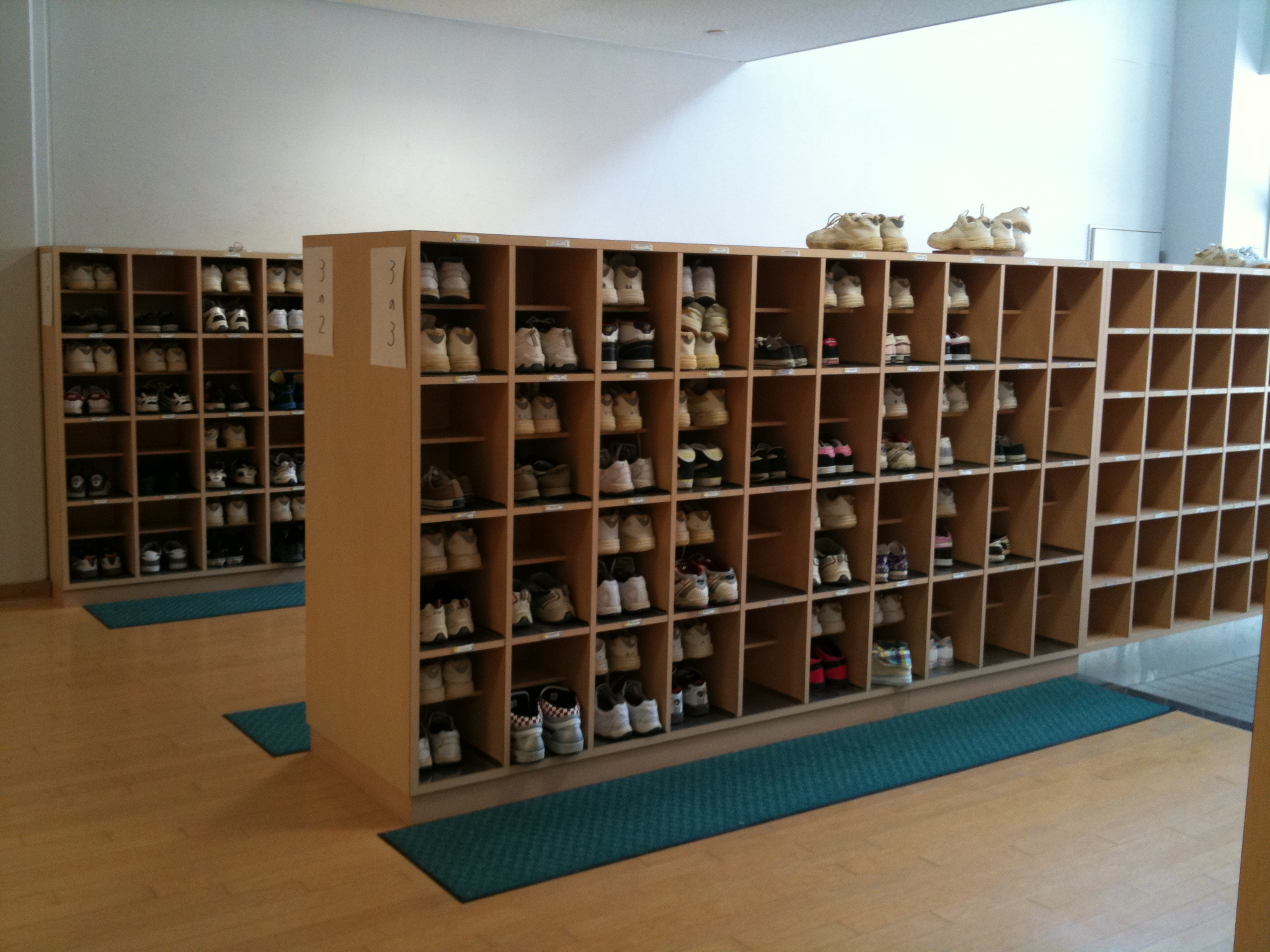
Student entrance of my junior high school
Exactly one year ago, I arrived in Japan to begin my tenure with the JET Programme as an Assistant Language Teacher (ALT) in Namerikawa, Japan.
My plan was to stay a year, save some money, see another side of the world and then come back to start my life in Chicago. Things moved so fast, and I decided in February to stay one more year. I am happy that I made that decision. I feel much more confident in my role as an ALT and look forward to promoting internationalization and the English language. My students are much more comfortable speaking to me, and I hope to get to know many more of them better this year.
I am helping with Toyama orientation this year and will be presenting with another ALT about lesson-planning strategies. For our presentation, I created a brief handout with lesson planning tips, which I copied below. Good luck to all the new JETs arriving in their towns this week!
- Prepare. During your down time in August, become familiar with New Horizon books 1-3 (Junior High School) and Eigo Noto (Elementary School). Try to think of fun games and worksheets beforehand. It will save you a lot of time during the year if you at least have a general knowledge of what specific words/grammar you will be teaching.
- Always be ready. Think of a good “ice-breaker” game to always use as a fallback. The game can be as simple as playing music and passing around a ball. When the music stops, ask the student holding the ball a question. Thanks to Jenson for this idea.
- Introduce yourself x 1,000,000. Get your self-introduction materials (pictures, video, posters) ready in August. If you teach at multiple elementary schools, always have your self-introduction materials ready throughout the year. You will be using them very often.
- Talk to other JETs. Other JETs often have great ideas for lessons, and because your textbook will most likely be the same, you can use their same idea or something similar. Also, be sure to read the Toyama Team Teaching handbook, which is written by ALTs.
- Scour the Internet. Check online for great ESL games and free teaching materials. Some good sites are:
- Multimedia planning. If you want to use PowerPoint or any other type of multimedia, which we highly encourage, plan ahead and make sure it works beforehand. This will save you from wasting time in class in case of a technology malfunction. Your school’s computer coordinator should be helpful when it comes to testing things out.
- Learn from your students. Observe and talk to your students. What are they into? What are their hobbies? What games do they like? Try to incorporate these interests into lesson plans. Even the most boring grammar lesson can be fun if it is followed by a fun game that includes pop culture references.
- Revise, revise, revise. Learn to change lesson plans immediately if you find out something doesn’t work out as planned. Don’t get discouraged. This happens to everyone. The more you teach, the more you will be able to think ahead about what works and what doesn’t.
Learning How to Remember
Posted on July 21, 2011 4 Comments

The news is a very fickle thing. As an old journalism adage goes, “If it bleeds, it leads.”
I understand this. The news is constantly changing. Journalists are attempting to accurately record history as it unravels. It simply isn’t possible to cover every story out there.
What bothers me, however, is that once a certain time elapses, a story can seemingly disappear, even if people are still in need of help.
In my opinion, this is what is slowly happening to the coverage of what is now referred to as the Great East Japan Earthquake that struck northeastern Japan on March 11, 2011, as well as other natural disasters that devastated New Zealand, Haiti, China, India and many other countries. I even forgot about the 2008 Sichuan Earthquake, which killed 70,000, until a friend reminded me of it recently.
In the weeks following the disasters in Tōhoku, I could barely open my computer without rushing to read the latest coverage. The BBC was my news outlet of choice, mainly because I found it the least sensational among the other big networks. Some images I saw on the news still upset me to this day, but I couldn’t look away.
Almost five months later, I still read a lot of the news coverage coming from Tōhoku, especially about radiation concerns, but articles are becoming few and far between. A recent 7.0 aftershock in Fukushima barely made the news.
It has been, after all, a busy few months for those in the news industry, with Osama bin Laden’s death and political uprisings in the Middle East. But in Japan and elsewhere around the world, people are still in the recovery process, even if it has been months or years since tragedy struck.
Although still deeply saddened by the triple disasters that hit Japan, I am very removed from any chaos – my town was not affected by the tragedies and is more than 200 miles from the Fukushima nuclear situation. Yet I still can’t wrap my brain around what happened to our neighbors in the northeast. Every time I run by the sea, I think of its beauty but also of its sheer force that could wipe out a town in an instant.
As a way to remember, I would like to highlight three projects that have moved me. I continue to hope for the best for people around the world who have been affected by natural disasters.
1. “Life in Tōhoku” by Will Shep Moore. Moore, a Coordinator for International Relations (CIR) in Nanto City, is a colleague and friend. He spent his spring vacation volunteering in the Tōhoku region and wrote about it for the Toyama for Charity blog.
2. “Arcade Fire in Haiti” by Régine Chassagne, a singer with the indie-rock group the Arcade Fire. In this article for The Guardian, Chassagne reflects on playing in her birth country, which is still recovering from last year’s 7.0 earthquake that killed more than 300,000. In my favorite part of the story, Chassagne writes about hope very tenderly: “Outside the gates of Cange, there is a newly built road that now leads all the way from Port-au-Prince. Thousands are walking to their mountain dwellings in peaceful silence and the only sound I hear is a lonely nocturnal rooster. A distant echo. In the rural mountains the moonlight seems thinner than usual, but Haitians have long mastered the art of finding their way in the dark.”
3.  A Beacon of Rebirth Poster Project. These posters, created by an advertising professional from Morioka in Iwate prefecture and a Tokyo-based photographer, are scattered throughout Japan, including on windows and doors in my tiny Japanese town. Each time I see the images, I am reminded of how many lives were lost in an instant, but also of the strength of human nature. With no picture, one poster says, “Our wish soars the skies far beyond the waves.” Another, with three men standing between piles of rubble as high as buildings, says, “We are staying here and now.”
I hope that is something we never forget to write about.
Train Stories #2: The Man Without a Violin
Posted on July 17, 2011 4 Comments
 (Namerikawa train station)
My initial train story was about a Japanese man from Chiba visiting Toyama just after the earthquake and tsunami in March.
On Monday, I had another interesting train encounter, though this time with an American man in Toyama for the summer.
It is not often you see a foreigner in Toyama who is not an Assistant Language Teacher (ALT) or Coordinator for International Relations (CIR) with the JET Programme. There are a few other English teachers who work for various companies, and other exchange students studying at Toyama University, but foreigners are still few and far between.
So when I saw a tall white American man in sleek biking clothes standing at the platform in Namerikawa, I was quite surprised.
I spotted him first on the Namerikawa train platform while waiting for a train to go to Uozu, a city about eight minutes away by train. He was carrying a disassembled bicycle, had short brown hair and looked to be in his early 30s. I was prepping for my Japanese class, so I did not have time to chat and we entered different cars of the train when it came. I went to my Japanese lesson and forgot about my spotting.
I took the train back to Namerikawa and listened to my iPod. Just as I stepped off the platform, however, I noticed him getting off the train from a different car.
“That is a little odd,” I thought. “We were on the same train coming back, too.”
I hoped he wasn’t a creepy stalker. Nonetheless, he looked friendly enough, so I took off my headphones and decided to say hello.
“Do you speak English?” I asked.
He smiled. “Of course. Where are you from?”
“America, the Chicago area. I teach English here. What brings you to Namerikawa?”
“My wife is from Takaoka [a city about 40 minutes by train from Namerikawa]. We live in America but come back to Japan for about a month every summer.”
He told me he has family in the Chicago area and that he likes to check out certain bookstores in this area of Japan. He just came back from visiting Kurobe, a city about 13 minutes by train from Namerikawa.
“My wife and I are both violinists. We live in Dallas now,” he explained.
He was about to see his wife perform at a local concert in Namerikawa. “I have kind of given up on performing, but my wife plays professionally with orchestras.”
By this time, we had walked to the parking lot for bikes.
I said goodbye and took out my key to unlock my bike.
He smiled and walked toward the concert hall. “Maybe see you around.”
 Sheila Burt